Sweden in Numbers
Contributors



Funding


Overview
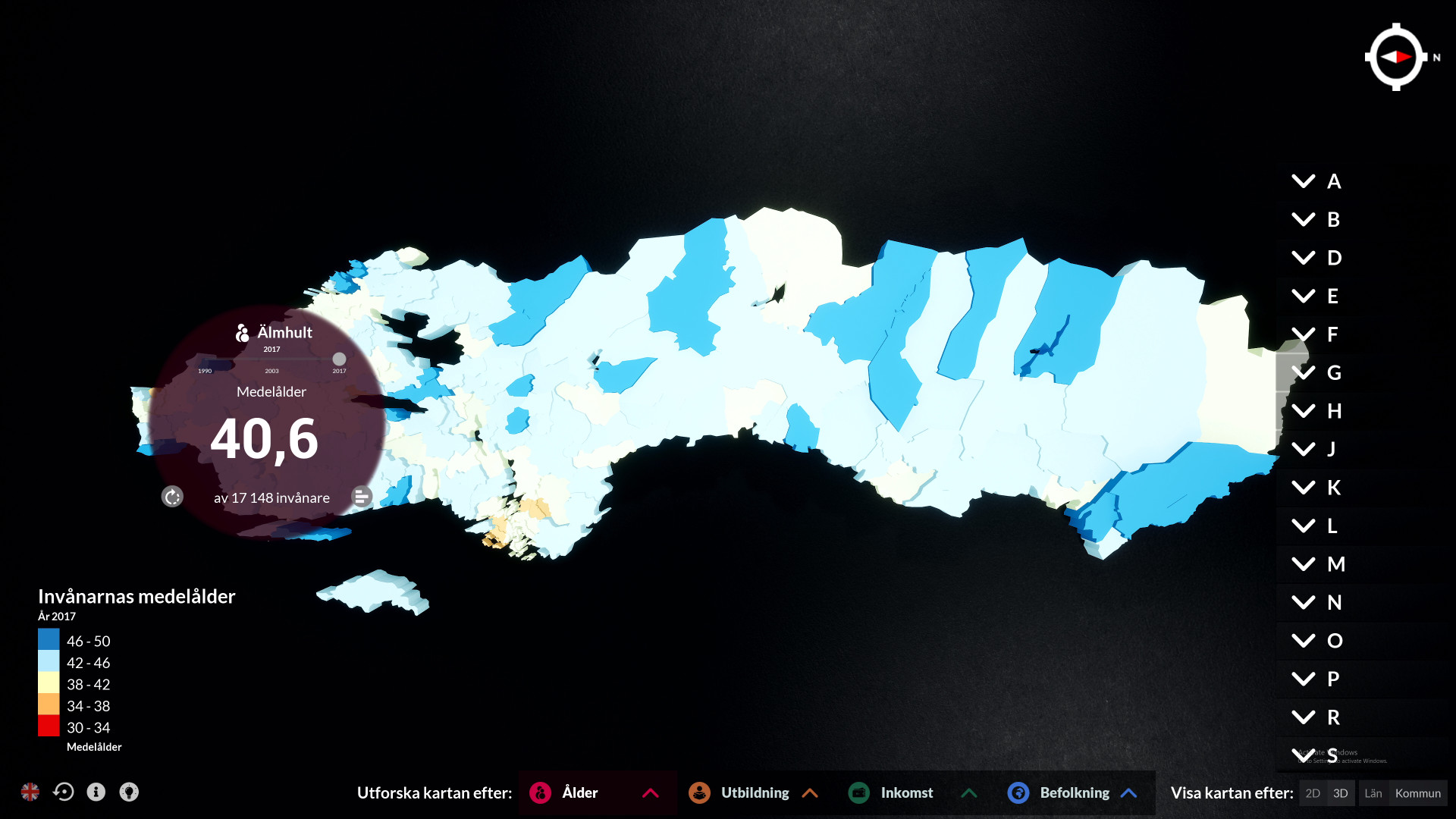
Sweden in Numbers is an interactive data visualization installation designed to let users explore the evolving demographics of the Swedish population. Originally developed as part of the Vislab initiative for Universeum and Visualiseringscenter C, the project transforms complex longitudinal register data into an intuitive, touch-based experience.
The application allows users to analyze how society has changed between 1990 and 2017, offering insights into all residents across the country. By utilizing data from the Institute for Analytical Sociology (IAS) and Statistics Sweden (SCB), the installation provides a scientifically grounded view of Swedish life over nearly three decades.
Key Features and Data
The software utilizes a high-resolution map of Sweden, allowing users to toggle between counties and municipalities. Visitors can filter and compare various demographic markers, including:
- Population & Age: Tracking the distribution of residents across different life stages.
- Education Levels: Visualizing the rise of higher education across different regions.
- Disposable Income: Mapping economic shifts and wealth distribution.
- Country of Origin: Exploring migration patterns and diversity within specific local communities.
Technical Implementation
Built using Unreal Engine 5, the system is designed for high-performance data throughput on large-scale touch tables and multi-display walls.
- Data Architecture: The project uses a SQL Docker container and a REST API to serve millions of data points in real-time.
- Visualization Techniques: Employs dynamic material instancing and custom shaders to animate transitions between years and data filters.
- Synchronized Display: Supports a "Master/Satellite" bubble UI, where a main control window on a touch table can drive high-resolution visualizations on surrounding wall monitors.
Collaboration
The project is a collaborative effort between:
- Linköping University (LiU): Lead development and research.
- Institute for Analytical Sociology (IAS): Data analysis and grouping logic.
- Universeum & Visualization Center C: Exhibition design and public outreach.
- Statistics Sweden (SCB): Source of population register data.